
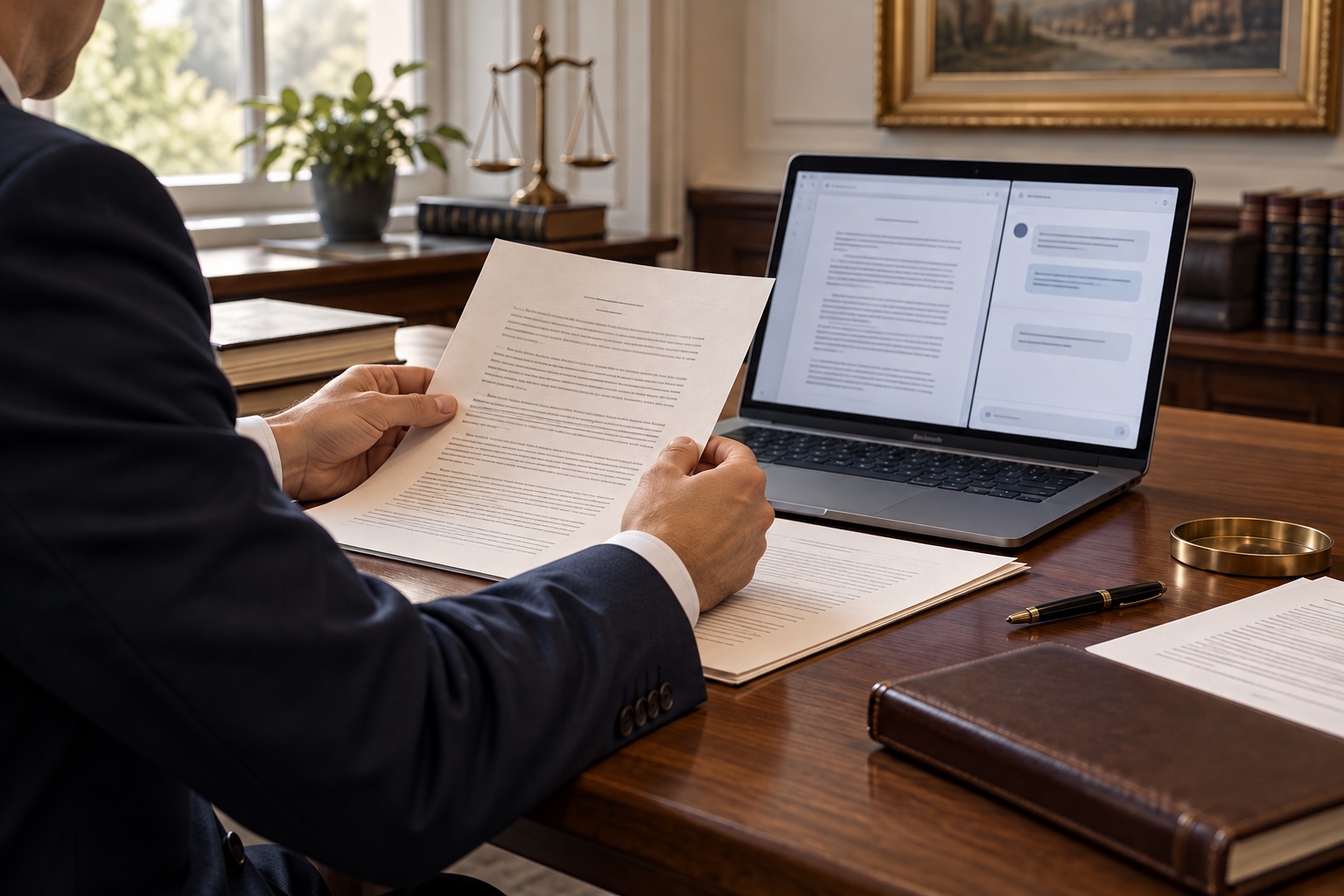
Short answer: AI tools can help you understand a legal topic, but they can also invent laws and court cases. Use them to prepare your questions, not to make decisions. Before you sign, file or rely on anything, have an attorney check it against the actual law.
Even judges have been caught out
In an October 20, 2026 commentary for Bloomberg Law, Oliver Roberts of WashU Law describes at least eight U.S. cases in which judicial orders or opinions cited fabricated AI-generated authorities. He reports no evidence of judicial discipline in the public record and argues for legislative safeguards. These are the author’s findings and recommendations. Read Roberts’s commentary in Bloomberg Law.
If an invented citation can reach a court order, it can also mislead someone preparing a contract, a will or a tax filing.
Why AI gets the law wrong
- Convincing language is not verification. AI generates text. Some tools also search sources, but a polished answer can still contain an invented case, a mistaken quotation or a citation that does not support the claim.
- The law changes. Tax rules, Florida statutes and healthcare regulations evolve. Check which jurisdiction, date and version of the law an answer relies on.
- Your facts change the answer. Where you live, how your business is structured and who owns an asset can change the analysis. A general answer may be wrong for you.
- Privacy depends on the tool. Providers differ in how they retain, share and use information. Do not assume that a public chatbot provides the confidentiality of a conversation with your attorney.
How to use AI safely
- Use it to learn the vocabulary and prepare your questions.
- Ask for sources, then confirm that each exists and supports the answer.
- Never sign, file or pay based only on an AI answer.
- Keep confidential business, health and family information out of public AI tools unless your attorney has confirmed an appropriate process.
- Bring what you found to your attorney, along with the sources and your actual documents.
The standard for Florida lawyers
The Florida Bar’s advisory Ethics Opinion 24-1 addresses generative AI: lawyers remain responsible for confidentiality, competence, fair billing and advertising compliance. They must verify the work. The opinion is advisory, not a binding rule.
Frequently asked questions
Can I use ChatGPT for legal advice?
It can help you explore a topic. Its output is not a substitute for advice from a licensed attorney who knows your circumstances. Verify anything you plan to act on.
Can AI make up court cases?
Yes. It can generate nonexistent case names, quotations and citations. The Bloomberg Law commentary above describes examples reaching judicial decisions.
Is it safe to upload my documents to an AI tool?
Do not upload confidential contracts, medical records or financial statements to a public tool without understanding its data policies and obtaining appropriate guidance. Ask your attorney how to share documents for your matter.
Are Florida lawyers allowed to use AI?
Yes. Opinion 24-1 explains the ethical obligations that accompany its use; AI does not remove the lawyer’s responsibility for the work.
Have a question an AI could not answer with certainty?
We advise families, business owners and physicians from our Boca Raton and Fort Lauderdale offices. Book a private consultation.
References
- Oliver Roberts, Judges Citing Fake AI-Generated Law Have Faced Few Consequences, Bloomberg Law, October 20, 2026 (commentary).
- The Florida Bar, Ethics Opinion 24-1, January 19, 2024.
Have a question about your circumstances?
Book a private consultationGeneral information only. This article is not legal advice and does not create an attorney-client relationship.